
A deep wrinkle takes years to form. It doesn't start on the skin's surface; it begins in the dermis, where collagen fibers gradually sag due to lack of renewal. At 25, collagen production begins to decline: about 1 to 1.5% per year, according to an academic dermatology review published in OAE Publishing (2020). By age 55, the deficit exceeds 25% of the initial capital.
Most guides on powerful natural anti-wrinkle solutions propose the same list: argan oil, aloe vera, honey, rosehip. These are real, documented active ingredients. But they are exclusively topical, designed to act on the superficial layers, not in the dermis where the fibers degrade.
What really happens under your skin when wrinkles appear
The skin is organized into three layers. Deep wrinkles originate in the second layer, the dermis, where collagen and elastin fibers form a mesh that maintains skin firmness and elasticity. When this mesh degrades, the surface sags.
Three mechanisms dominate this process:
- Collagen loss : production decreases by 1 to 1.5% per year starting at age 25. Over four decades, about a quarter of the initial capital disappears.
- Elastin degradation : the skin gradually loses its ability to return to its original shape after movement or facial expression.
- Deep dehydration : the concentration of natural hyaluronic acid also decreases with age, reducing the skin's ability to retain water in the dermis.
Photoaging accelerates all of this: according to the Skin Cancer Foundation, UV exposure is responsible for 80 to 90% of visible skin changes, including wrinkles, spots, and loss of firmness. This data highlights the crucial role of sun protection in any anti-wrinkle strategy, natural or not.
For a detailed analysis of the causes and a prevention strategy by decade, the article how to prevent wrinkles from age 30 covers these mechanisms in depth. Here, we focus on the active ingredients themselves, and why their effectiveness also depends on the chosen method.

Argan oil, bakuchiol, aloe vera: what these natural active ingredients actually do
Not all natural topical anti-wrinkle active ingredients deserve the same level of trust. Their effectiveness varies greatly depending on the mechanism of action and available clinical data.
Argan oil and olive oil
Argan oil is rich in vitamin E (tocopherols) and essential fatty acids, oleic acid, and linoleic acid. It strengthens the skin barrier, reduces transepidermal water loss, and offers antioxidant protection on the superficial layers of the dermis. Regular use improves radiance and surface hydration.
Olive oil, often cited in traditional remedies, contains polyphenols (including oleocanthal) and vitamin E. Its antioxidant properties are well documented. However, no controlled clinical study demonstrates a structural action on existing collagen fibers; it is an active ingredient for protection and comfort, not for reconstitution.
Rosehip oil
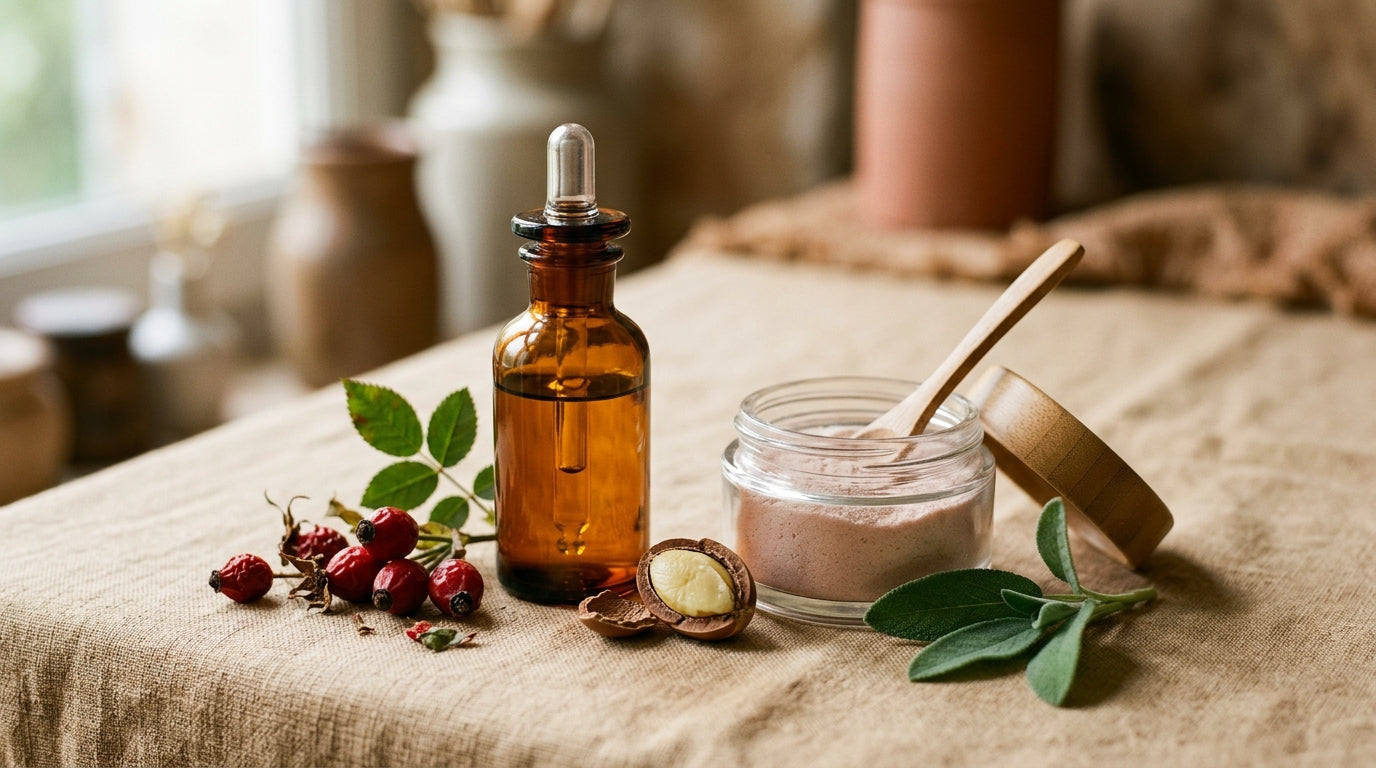
It goes slightly further. Rosehip oil contains natural retinoic acid in low concentrations, which stimulates cell renewal and can improve the texture and appearance of superficial fine lines. Studies observe a measurable improvement in radiance and texture after 6 to 8 weeks of regular facial application. However, its spectrum of action remains limited to the epidermal layers and does not exceed a few tens of microns in depth.
Bakuchiol, the only natural topical active ingredient with a solid RCT on wrinkles
This is where the level of evidence changes category. Bakuchiol is a natural active ingredient extracted from Psoralea corylifolia, which stimulates the same cellular receptors as retinol (RAR receptors), without the associated irritating effects: no flaking, no photosensitivity.
A double-blind randomized clinical trial published in the British Journal of Dermatology (Dhaliwal et al., 2019) directly compared 0.5% bakuchiol and 0.5% retinol in 44 patients over 12 weeks. Result: equivalent reduction in wrinkle surface area and hyperpigmentation of about 20%, with significantly less flaking and tingling from bakuchiol.
This is the only peer-reviewed RCT comparing a natural topical active ingredient to retinol for wrinkles. It justifies bakuchiol being treated separately, not as just another vegetable oil, but as an active ingredient with an identified and clinically validated mechanism.
Aloe vera, beyond its moisturizing reputation
Aloe vera is often reduced to a soothing gel. A clinical study published in the Annals of Dermatology (PMC, 2009), conducted on 30 women over 45, tested an oral supplementation of 1,200 mg/day for 90 days. It measured a significant improvement in elasticity and wrinkles, with a 4.74-fold increase in the expression of type I procollagen gene in fibroblasts, meaning a direct boost to the cellular machinery for collagen production.
This result is structurally important: it indicates that oral aloe vera acts on collagen synthesis itself, not just on superficial hydration.
Honey
Excellent humectant, recognized antimicrobial properties, improved superficial hydration. But no controlled clinical trials document any action on deep wrinkles. It is an active ingredient for comfort in a routine, not an anti-wrinkle active in the mechanical sense of the term.
What topical treatments miss, and how to act from within
Even the best-documented topical active ingredients, bakuchiol, rosehip, have a structural limit: they do not penetrate the deep dermis. Lost collagen cannot be replenished by external application. This is precisely where natural oral active ingredients represent the most underexploited angle in the fight against the signs of aging.
Hydrolyzed marine collagen, what science really says
The question often arises: is ingested collagen simply degraded into amino acids, with no specific effect on the skin? The debate is real, and caution is justified. Two recent meta-analyses, without declared conflicts of interest, provide the most solid data available:
- A meta-analysis of 26 randomized controlled trials involving 1,721 patients (PMC / Nutrients, 2023) shows statistically significant improvements in skin hydration (p < 0.00001) and elasticity (p < 0.00001).
- A second meta-analysis of 14 RCTs on 967 participants (PMC, 2024) confirms these results on hydration, elasticity, wrinkles, and transepidermal water loss.
The honest nuance: these results are most robust for hydration and elasticity. The effect on established deep wrinkles remains debated in the literature, with some industry-funded studies showing more pronounced effects than independent studies. Hydrolyzed collagen supports the skin from within, improving its texture and resistance; it does not make wrinkles that have formed over years disappear.
Formulation matters as much as the raw material. Hydrolyzed collagen at 500 daltons shows significantly higher bioavailability than forms at 2,000 daltons or more: low molecular weight peptides cross the intestinal wall and reach target tissues, whereas less hydrolyzed forms remain largely unabsorbed. To delve deeper into the role of collagen in preventing aging, consult how collagen helps prevent aging.
Liposomal vitamin C, enzymatic cofactor, not just an antioxidant
Vitamin C is often presented as "good for collagen." This is true, but the mechanism is more precise. It is an essential cofactor for prolyl-hydroxylase and lysyl-hydroxylase, the enzymes that stabilize the collagen triple helix during its synthesis. Without sufficient vitamin C, the produced fibers do not assemble correctly and degrade prematurely. Liposomal vitamin C improves bioavailability: encapsulated in lipids, vitamin C crosses the intestinal wall before being released into the bloodstream.
Oral hyaluronic acid
A randomized double-blind study compared two forms of oral hyaluronic acid (120 mg/day, 12 weeks) to a placebo in 60 subjects; the high molecular weight HA group (300 kDa) showed a significant reduction in crow's feet wrinkles as early as 8 weeks (Oe et al., Clinical, Cosmetic and Investigational Dermatology, 2017). A meta-analysis of 7 RCTs confirms improvements in hydration, elasticity, and wrinkle depth after 12 weeks of supplementation (Journal of Drugs in Dermatology, 2025).
At June Laboratoire, 84% of users of the Raffermir® complex, which combines 500 dalton marine collagen, hyaluronic acid, biotin, and vitamin C, noticed more hydrated and plump skin with a visible reduction in fine lines after 2 months of treatment (+100 independently collected results). Starting at €29.90 per month, it is the most complete formula in the range for addressing the signs of aging from within.
For a single-ingredient approach, marine collagen capsules (500 daltons) are available from €19.90. Results generally appear between 8 and 12 weeks of regular intake.
How to build a natural anti-wrinkle routine that lasts over time
Topical and oral treatments work at different levels; they complement each other rather than replacing each other.
In the morning : sun protection first. This is the most documented anti-aging step, before any natural active ingredient. Then a targeted topical active ingredient depending on skin tolerance: bakuchiol for skin that wants the retinol effect without irritation, plant-based vitamin C serum for combination skin.
In the evening : rosehip or argan oil as a nourishing treatment. A patch test on the forearm is still recommended before introducing a new vegetable oil, especially rosehip on acne-prone skin.
As an oral treatment : marine collagen, hyaluronic acid, or a complete complex in the morning, every day. Consistency over 8 to 12 weeks is the basic condition; a discontinuous treatment does not produce the same results as regular intake. Complementary techniques such as facial massage or gua sha improve circulation and muscle tone in the face; they do not replace active ingredients, but they optimize their environment.
The article prevent wrinkles from age 30 details prevention strategies by decade for further information. For a more global approach to anti-aging care, discover how to prevent skin aging with adapted care.
What accelerates skin aging, and habits that protect against it
The effectiveness of any natural anti-wrinkle active ingredient, topical or oral, depends on the context in which it operates. Certain behaviors actively degrade collagen and neutralize the benefits of even the best formulated treatments.
Smoking reduces oxygen supply to fibroblasts, the collagen-producing cells. Excessive alcohol disrupts vitamin A synthesis and worsens oxidative stress. Excessive sugar causes glycation, which stiffens existing collagen fibers. Chronic stress elevates cortisol, which activates metalloproteinases, enzymes that directly degrade collagen and elastin.
Omega-3 EPA/DHA inhibit the production of pro-inflammatory cytokines that activate these same metalloproteinases, according to a cross-sectional study cited in several dermatology syntheses. Polyphenols (resveratrol, curcumin, green tea) and dietary vitamin C neutralize free radicals involved in skin fiber degradation.
These are not direct anti-wrinkle active ingredients. But they condition the effectiveness of those that are.
Frequently Asked Questions
How long does it take to see the effects of a natural anti-wrinkle product?
Well-formulated topical active ingredients, such as bakuchiol and rosehip oil, show visible effects on texture and radiance between 4 and 8 weeks of regular application. For oral active ingredients, such as hydrolyzed collagen and hyaluronic acid, clinical studies observe statistically significant improvements starting from 8 to 12 weeks. Consistency is the key variable: a discontinuous treatment does not produce the same results as regular intake over 2 to 3 months.
Can oral collagen really reduce wrinkles, what does science say?
The strongest data concerns skin hydration and elasticity: two recent meta-analyses (26 RCTs on 1,721 patients in 2023, 14 RCTs on 967 patients in 2024), without declared conflicts of interest, show statistically significant improvements on these two markers. The effect on established deep wrinkles is more debated in the literature, depending notably on the quality of hydrolysis (molecular weight), the duration of intake, and the specific mechanisms of each patient. 500 dalton hydrolyzed marine collagen offers the best bioavailability available on the market.



11 comments
💼 + 2 BTC. BINANCE CRYPTO GIVEAWAY. Sign up 👉🏻 dc4958ca.giveaway-8y3.pages.dev/?hs=96525aa0a9b2d91da376e3fe53eb785c& 💼
bdjft6
📊 Transfer of funds to your name. Receive a funds transfer >>> graph.org/TRANSACTION-05-05-6?hs=481dae3c3888709553614b908a48c8e5& <<< 📊
lcmp6d
📉 + 36,824.44 USD 🔥➤ graph.org/BALANCE-3682444-USD-04-21-2?hs=481dae3c3888709553614b908a48c8e5& 📉
mbketx
🤑 Transfer of funds to your name. RECEIVE >>> graph.org/TRANSACTION-05-05-6?hs=612222e999c29327ab7fcf4d5a003025& <<< 🤑
lk8uan
💲 Transfer of funds to your name. Receive a funds transfer >>> graph.org/TRANSACTION-05-05-6?hs=96525aa0a9b2d91da376e3fe53eb785c& <<< 💲
q1o3o4
Leave a comment
This site is protected by hCaptcha and the hCaptcha Privacy Policy and Terms of Service apply.